Barbara Vine is one of my favorite writers. I have about three modern writers that I'll read anything they write, Barbara Vine (who also writes as Ruth Rendell), is one of them, the other two being P.D. James and Minette Walters.
This book was not one of my favorites though. I enjoyed it well enough, but I didn't love it.
The story is told by someone who is reflecting back on an event in her life. She's telling a story about a situation that she observed, something that was happening around her, but something that did not directly involve her. She was hired as a nurse for a family to care for their adult son. During her stay, she learns many disturbing family secrets and witnesses many strange events, leading ultimately to a tragedy.
But the story doesn't leave much of a impact. I felt no urgency to finish the book. It didn't arouse any intense feelings, no anger or suspense or fear. It does paint an interesting portrait of rural English life, as do many of her books. I felt like there was too much distance between the narration and the action of the story. Readers were never allowed inside the heads of the people actually involved, so you're left to assumption and speculation along with the narrator.
If you're looking for a good suspense, thriller though, there are several others that I would recommend over this. Two of my favorite Barbara Vine books are No Night is Too Long and Dark-Adapted Eye. I highly recommend both of those. This one, though, not so much.
Saturday, July 01, 2006
Tuesday, May 09, 2006
The Forgetting Room by Nick Bantock
I read this book after I went to Spain. The events in this book take place in Ronda and feature a bridge which I saw on my trip.
I thoroughly enjoyed this book, mostly because it's about painting. The Forgetting Room is the room where the narrator and his grandfather before him would enter to become absorbed in their art. Painting is used as a form of escape. I think anyone who paints can relate to the feeling. I forget sometimes how much I love painting, and after reading this book I was reminded of how much I love falling into a painting. It's never about the finished product, but rather the process of creating the work.
This is a nice book, complete with some beautiful illustrations.
I thoroughly enjoyed this book, mostly because it's about painting. The Forgetting Room is the room where the narrator and his grandfather before him would enter to become absorbed in their art. Painting is used as a form of escape. I think anyone who paints can relate to the feeling. I forget sometimes how much I love painting, and after reading this book I was reminded of how much I love falling into a painting. It's never about the finished product, but rather the process of creating the work.
This is a nice book, complete with some beautiful illustrations.
Tenth Circle by Jodi Picoult
I was intrigued by this book because of the use of graphic art -- "comic book" art -- within the novel. I'm something of a comic book fan. But 26 pages into this book, I have decided to stop reading it. After reading a scene in which a fourteen year old girl goes to the school bathroom and tries to slit her wrists with a broken makeup compact, I've decided this book is not for me. The girl is just soooo depressed because her boyfriend broke up with her. She's fourteen! Granted I probably have no sympathy for the situation because I was never a normal teenager, I was always more interested in literature and art and music and sports than in the boys in my school. I dreamed of movie stars and bad boy rockers. I never longed for the smelly kid sitting next to me in study hall.
I couldn't get any further into the book because reading that particular scene sent my mind reeling with angry thoughts. I couldn't focus on the story anymore. What kind of upbringing did this child have that she thinks a boy is worth so much tragedy? How pathetic and empty is her life that she thinks everything is over because of a boy? The beginning of the novel talks about how wonderful her father was at being a stay at home dad, but something was off with this kid. I'm simply not interested in reading this kind of melodrama.
There are so many books I want to read right now, I'm not wasting any more time with this one.
I couldn't get any further into the book because reading that particular scene sent my mind reeling with angry thoughts. I couldn't focus on the story anymore. What kind of upbringing did this child have that she thinks a boy is worth so much tragedy? How pathetic and empty is her life that she thinks everything is over because of a boy? The beginning of the novel talks about how wonderful her father was at being a stay at home dad, but something was off with this kid. I'm simply not interested in reading this kind of melodrama.
There are so many books I want to read right now, I'm not wasting any more time with this one.
Saturday, April 15, 2006
Memoirs of a Geisha by Arthur Golden
I picked up a copy of the book at Half-Price Books during one of their big extra 20% sales, but it was another year or so before I got around to reading it. I included this on my reading list at beginning of the year.
When I packed for my week in Spain, I took several books, this being one of them. I decided on this book because on the plane from Dallas to London, I noticed that the movie, Memoirs of a Geisha, was being shown on the return flight. I wanted to have this read before I watched the movie.
This is the story of a young woman, trained to be a geisha. This tells the story of her experiences and the rituals involved in the world of geishas. This is fascinating in that it describes an experience so foreign to most of us. These women, they traveled on this path as a means to arrive at a better life in a society that provided women limited opportunities. They lived in luxury that would have not been available to them otherwise. However, still their lives were completely dictated by the actions and desires of the men they served.
A scene is described in which the woman, years later, is introduced in New York as a former geisha. She said she can tell she's looked at oddly, and can tell that she is being reagarded as a prostitute. But she so accurately points out, were her actions so different than the wealthy wife judging her? The geisha's actions are more formal and precise, the intent more obvious, but so many women follow a similar path. They paint their faces, dress a certain way, act a certain way, all in their attempts to gain the company and adoration of certain men, men with money and prestige, men who will care for them.
Despite the cover quite clearly stating that this book is a "novel" I read the entire thing under the assumption that it was supposed to be a true story. My own fault, I wasn't paying attention to the cover, I was thrown by the use of the word "memoir" in the title. Upon completing the book, I read the pages following the end, the pages explaining the character in the story is entirely made up.
While I found the description of the lifestyle to be interesting, the "love affair" in the book seemed to detract from the story. It wasn't very believable, which makes sense now that I know the story is fiction.
Ovarall though, it's an enjoyable book, especially if you like stories about different cultures and experiences.
When I packed for my week in Spain, I took several books, this being one of them. I decided on this book because on the plane from Dallas to London, I noticed that the movie, Memoirs of a Geisha, was being shown on the return flight. I wanted to have this read before I watched the movie.
This is the story of a young woman, trained to be a geisha. This tells the story of her experiences and the rituals involved in the world of geishas. This is fascinating in that it describes an experience so foreign to most of us. These women, they traveled on this path as a means to arrive at a better life in a society that provided women limited opportunities. They lived in luxury that would have not been available to them otherwise. However, still their lives were completely dictated by the actions and desires of the men they served.
A scene is described in which the woman, years later, is introduced in New York as a former geisha. She said she can tell she's looked at oddly, and can tell that she is being reagarded as a prostitute. But she so accurately points out, were her actions so different than the wealthy wife judging her? The geisha's actions are more formal and precise, the intent more obvious, but so many women follow a similar path. They paint their faces, dress a certain way, act a certain way, all in their attempts to gain the company and adoration of certain men, men with money and prestige, men who will care for them.
Despite the cover quite clearly stating that this book is a "novel" I read the entire thing under the assumption that it was supposed to be a true story. My own fault, I wasn't paying attention to the cover, I was thrown by the use of the word "memoir" in the title. Upon completing the book, I read the pages following the end, the pages explaining the character in the story is entirely made up.
While I found the description of the lifestyle to be interesting, the "love affair" in the book seemed to detract from the story. It wasn't very believable, which makes sense now that I know the story is fiction.
Ovarall though, it's an enjoyable book, especially if you like stories about different cultures and experiences.
Monday, March 13, 2006
Effects of Light by Miranda Beverly-Whittemore
This book intrigued me partly because it seemed to be very much about art and people involved in the art world.
Here's the basic premise of the story: The two daughters of a college art professor posed nude on a regular basis for their father’s photographer friend, Ruth. After the photos are displayed in a well-known gallery, and gain national attention as a result of the subject matter, the youngest daughter is kidnapped and killed. This is assumed to be connected to the photos. The older daughter becomes angry and leaves. Changes her name, cuts off all contact with her past. Years later, she receives a letter saying she needs to return home to retrieve a package. So she drops everything and returns to Washington state and reconnects with her past. She stays with family friends, and tries to decipher her father's notes about art -- a "ground-breaking" book on which he spent his life working. In her quest for information, she also uncovers several family secrets and love triangles involving her parents and tries to make peace with the loss of her sister and father, who had a fatal heart attack after his daughter's murder.
The present story follows the older daughter, while their past is revealed through first person flashbacks belonging to the younger daughter.
I thought I would enjoy reading about people who view art as a central point of their lives. But instead, reading this book made me aware of what I don't like about people who take art too seriously.
In the novel, the photos, when displayed created a great deal of controversy. People were offended by the use of children in nude photos. When describing this, the book takes a decidedly pro-photos stance. Then, through the characters dialogue, proceeds to explain why people were wrong to be offended, why the photos were not offensive, but rather "beautiful". The children in the book insist that they wanted to do the photos, this was their choice. This goes on for pages, the small child insisting that she loves the photos, they're a huge part to her life, a part of her life that she treasures. But as I read this, I kept thinking, you're only five (or whatever too young age she was)! How does a five year old know what she wants? At that age, children just want to make people happy. The father and photographer discuss at length how wonderful it is that the photos chronicle the children's growth, they show the transformation from a child to a young woman (in the case of the older daughter).
Their defense of the photos is presented in such a way to indicate that anyone who didn't agree with them was simply not intelligent enough to fully understand the importance of art.
Essentially, the book angered me. I do understand art. I appreciate art. I even appreciate different, unusual and controversial art. But I don't think that children should ever be exploited for the purpose of art. As I read this book, regardless of how the photo sessions or photographs were described, I felt like the children were being used as nothing more than props for the photographer and then convinced that they wanted to be objectified. This made me think of the ways in which abuse victims are convinced that they somehow enjoyed or provoked the abuse, when in fact they are too young to know otherwise. The father seemed to be so involved in his theories on art that he was oblivious as to what was happening to his children. As long as they were experiencing "art", nothing else mattered to him.
Another scene that bothered me: the older daughter, as an adult, is confronting her boyfriend, claiming he doesn't really know her and so she's going to show him her real self. To do this, she strips in front of him and and has some bizarre breakdown of sorts, pointing to her naked body shouting "this is me." Her actions seemed to support my belief that by being a prop in photographs, she now views herself as nothing more than a body. It was an uncomfortable scene to read and I almost stopped right there. But I stuck with it until the end, because I was near the end at that point.
I didn't enjoy this book. I don't recommend reading it at all.
Here's the basic premise of the story: The two daughters of a college art professor posed nude on a regular basis for their father’s photographer friend, Ruth. After the photos are displayed in a well-known gallery, and gain national attention as a result of the subject matter, the youngest daughter is kidnapped and killed. This is assumed to be connected to the photos. The older daughter becomes angry and leaves. Changes her name, cuts off all contact with her past. Years later, she receives a letter saying she needs to return home to retrieve a package. So she drops everything and returns to Washington state and reconnects with her past. She stays with family friends, and tries to decipher her father's notes about art -- a "ground-breaking" book on which he spent his life working. In her quest for information, she also uncovers several family secrets and love triangles involving her parents and tries to make peace with the loss of her sister and father, who had a fatal heart attack after his daughter's murder.
The present story follows the older daughter, while their past is revealed through first person flashbacks belonging to the younger daughter.
I thought I would enjoy reading about people who view art as a central point of their lives. But instead, reading this book made me aware of what I don't like about people who take art too seriously.
In the novel, the photos, when displayed created a great deal of controversy. People were offended by the use of children in nude photos. When describing this, the book takes a decidedly pro-photos stance. Then, through the characters dialogue, proceeds to explain why people were wrong to be offended, why the photos were not offensive, but rather "beautiful". The children in the book insist that they wanted to do the photos, this was their choice. This goes on for pages, the small child insisting that she loves the photos, they're a huge part to her life, a part of her life that she treasures. But as I read this, I kept thinking, you're only five (or whatever too young age she was)! How does a five year old know what she wants? At that age, children just want to make people happy. The father and photographer discuss at length how wonderful it is that the photos chronicle the children's growth, they show the transformation from a child to a young woman (in the case of the older daughter).
Their defense of the photos is presented in such a way to indicate that anyone who didn't agree with them was simply not intelligent enough to fully understand the importance of art.
Essentially, the book angered me. I do understand art. I appreciate art. I even appreciate different, unusual and controversial art. But I don't think that children should ever be exploited for the purpose of art. As I read this book, regardless of how the photo sessions or photographs were described, I felt like the children were being used as nothing more than props for the photographer and then convinced that they wanted to be objectified. This made me think of the ways in which abuse victims are convinced that they somehow enjoyed or provoked the abuse, when in fact they are too young to know otherwise. The father seemed to be so involved in his theories on art that he was oblivious as to what was happening to his children. As long as they were experiencing "art", nothing else mattered to him.
Another scene that bothered me: the older daughter, as an adult, is confronting her boyfriend, claiming he doesn't really know her and so she's going to show him her real self. To do this, she strips in front of him and and has some bizarre breakdown of sorts, pointing to her naked body shouting "this is me." Her actions seemed to support my belief that by being a prop in photographs, she now views herself as nothing more than a body. It was an uncomfortable scene to read and I almost stopped right there. But I stuck with it until the end, because I was near the end at that point.
I didn't enjoy this book. I don't recommend reading it at all.
Sunday, February 26, 2006
Year of Magical Thinking by Joan Didion
Magical Thinking, as used in the title of this book, is the idea that your internal thoughts have some sort of control on the outside world. In this case, it was Didion believing that she had to keep her husband’s shoes because he would need them when he came back, after dying at the dinner table of a heart attack.
This book, as most people know, is about the year after Didion’s husband’s death. It is very much about the difficulty of suddenly and unexpectedly losing someone who has always been there. Everything was fine one moment and the next it was over.
Didion does an excellent job of describing the suddenness and the extreme feeling of loss. This is very well written. When I started reading this, I had difficulty putting it down because as absurd as this sounds, I felt as if I was leaving her alone if I stopped reading. And her experience was so awful, I didn’t want to leave her alone. Yet that is what this book is about, being alone for the first time in 40 years.
She describes her marriage as different from the typical marriage. She and her husband were friends and co-workers and they talked to each other in ways that families do not seem to communicate. Maybe this is the trick to being married for so long – not adhering to the stupid ideas society present about marriage – wife stays home and keeps house, husband goes off to the office. Didion and her husband seemed to have a collaboration that worked very well for them. They traveled to places all over the world and they sat down at home and “planned.”
On top of the loss of her husband, the year after his death, she is also dealing with the illness of her daughter, who I believe died after this book was published. This is a sad book, but also, I feel like it is a valuable book. The book provides insight to the process of grief and mourning. It also presents a story of what must have been a happy marriage and loving family, and because of that, I enjoyed reading this.
This book, as most people know, is about the year after Didion’s husband’s death. It is very much about the difficulty of suddenly and unexpectedly losing someone who has always been there. Everything was fine one moment and the next it was over.
Didion does an excellent job of describing the suddenness and the extreme feeling of loss. This is very well written. When I started reading this, I had difficulty putting it down because as absurd as this sounds, I felt as if I was leaving her alone if I stopped reading. And her experience was so awful, I didn’t want to leave her alone. Yet that is what this book is about, being alone for the first time in 40 years.
She describes her marriage as different from the typical marriage. She and her husband were friends and co-workers and they talked to each other in ways that families do not seem to communicate. Maybe this is the trick to being married for so long – not adhering to the stupid ideas society present about marriage – wife stays home and keeps house, husband goes off to the office. Didion and her husband seemed to have a collaboration that worked very well for them. They traveled to places all over the world and they sat down at home and “planned.”
On top of the loss of her husband, the year after his death, she is also dealing with the illness of her daughter, who I believe died after this book was published. This is a sad book, but also, I feel like it is a valuable book. The book provides insight to the process of grief and mourning. It also presents a story of what must have been a happy marriage and loving family, and because of that, I enjoyed reading this.
Myth of You and Me by Leah Stewart
I picked up this book because of the title. Silly fact about me – "Myth" is one of my favorite words. I throw it out whenever possible. So the title sounded all dark and mystical. I tend to be much more interested in stories about friendships than romantic relationships and I knew this was a story about friendship. That's all I knew about it.
I didn't realize until I started reading it that it was about a thirty year old looking back on her life -- Someone who didn't feel comfortable in her current setting, someone who was always wanting to run. Suffice it to say instantly I felt a connection with the main character. Also, as I read more of the book, I found it startling that it was about girls growing up in the Southwest and the after effects of living with an abusive mother. Seldom are these situations written about in a realistic manner. There were so many elements in this book that felt like they could have been passages from my life, from driving the west Texas roads to spending your best college days in the newsroom.
Overall, I really enjoyed this book. I liked the way it explored the depths of friendships, the hold a friend can have over you, the way one’s betrayal can damage you. At what point do you walk away? What do you forgive? And who are you really hurting, what do you have to gain when you do decide it is time to end a friendship?
This is a really nice book. While I've never experienced any sort of situation like the one mentioned in the book, I, like anyone who has ever had a strong friendship, can certainly relate to the themes of holding on and letting go and choosing to forgive or forget.
My only issue with this book was what was an attempt at suspense. What is the package Camaron is taking to Sonia? I suggest you not focus too much on that. It is interesting, but it isn't nearly as important as the buildup presents it to be. The true value of the book is the small details that make the intensity of the friendship feel true.
I didn't realize until I started reading it that it was about a thirty year old looking back on her life -- Someone who didn't feel comfortable in her current setting, someone who was always wanting to run. Suffice it to say instantly I felt a connection with the main character. Also, as I read more of the book, I found it startling that it was about girls growing up in the Southwest and the after effects of living with an abusive mother. Seldom are these situations written about in a realistic manner. There were so many elements in this book that felt like they could have been passages from my life, from driving the west Texas roads to spending your best college days in the newsroom.
Overall, I really enjoyed this book. I liked the way it explored the depths of friendships, the hold a friend can have over you, the way one’s betrayal can damage you. At what point do you walk away? What do you forgive? And who are you really hurting, what do you have to gain when you do decide it is time to end a friendship?
This is a really nice book. While I've never experienced any sort of situation like the one mentioned in the book, I, like anyone who has ever had a strong friendship, can certainly relate to the themes of holding on and letting go and choosing to forgive or forget.
My only issue with this book was what was an attempt at suspense. What is the package Camaron is taking to Sonia? I suggest you not focus too much on that. It is interesting, but it isn't nearly as important as the buildup presents it to be. The true value of the book is the small details that make the intensity of the friendship feel true.
Monday, January 02, 2006
Are Men Necessary? by Maureen Dowd
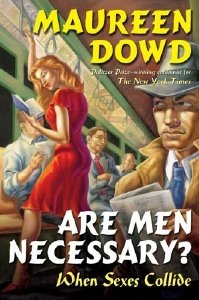
I think Maureen Dowd is pretty darn brilliant. She's so very, very smart and funny and really knows what is going on in the world.
Sometimes the universe places in your hands exactly what you need. I bought this book using a gift card someone gave me for my 30th birthday. Talk about being knocked on my ass. That's a rough birthday. This book though did quite a bit in helping me get back on my feet. I didn't get around to reading this book until the Christmas holidays. It was exactly what I needed as I faced my annual holiday depression.
I've hit this age where all of my friend are now tending to their children and husbands and I don't really have anyone to go out with and go places and such. I don't have any interest in the husband and children thing. None at all. I don't say that as a defense mechanism, but simply as fact. I've never understood the allure of it all. I like not being dependent on others. I like making decisions that affect only me. Sometimes though, I don't like being alone. Doesn't mean I want a man, sometimes just a friend who has time to sit and talk would be nice. That rambling there, it is sort of related to some of the ideas expressed in this book. Not to mention that reading this book felt like having a nice conversation with a like-minded girl-friend.
Much of this book is a reflection of Dowd's disappointment over what seems to be the death of feminism. What the hell happened? Now all these women are doing anything and everything possible to acquire a man, to be a wife and a mommy and that seems to be all that matters. Those of us not interested in those things, we're left standing on the side feeling very awkward and confused. What's wrong with us? Why don't we want that stuff?
One of my many dreams, when I was young and naive and had never set foot outside of a small town and still believed dreams were attainable, was to be a columnist. I thought at the time that I actually had things to say that people would want to read. But now that the real world has beat me down, I've become aware of the fact that there are people signifcantly more talented than me saying the things I would like to say, but in much more readable ways.
So when I'm reading Dowd's work, I'm thinking, "exactly, that's just how I feel." Of course, there is no way I could write those thoughts and ideas in such a way. But it is nice to be able to read them.
That's actually another subject on which Dowd touches. Men tend to go after whatever they want, without regard to whether they will fail or succeed. Almost as if they assume they will always suceed and if they don't, they just keep trying. A woman (in general, of course this doesn't apply to everyone) on the other hand, she waits, and waits and waits until she knows she will suceed. In essence she doesn't take chances and probably misses out on a lot of opportunities. I saw myself in this. I don't try things unless I know I'll succeed. Being that I can't see into the future, and very few things provide guaranteed results... We won't even talk about all my missed opportunities.
Overall, though, I felt the underlying message of the book was that men are not essential to a woman's life. Women are quite capable of managing on their own. We don't need men to take care of us, and we don't need men to dictate the ways in which we take care of ourselves and our surroundings. They seem to cause a lot of trouble. In the end, what made me feel a whole lot better about reading this is that I realized, or rather, I had my beliefs re-confirmed that it is very much okay to be single and essentially alone. This whole "finding a man thing" is way overhyped. Simply a product of marketing. There are many other things in life to which I can direct my focus that do not involve men or "hooking up" with men.
I think all women, single ones especially, and probably a few men, would benefit from reading this book.
Read during the week of Christmas, finished on Jan. 1, 2006.
Saturday, November 26, 2005
Made in Detroit by Paul Clemens
This book got great reviews. I was under the impression that this was a book about Detroit, and thought it might be interesting.
But I didn't like this book at all. Not one bit. I felt angry reading it. It was a short book, but took me forever to read and I found myself bitching about it to anyone who made the mistake of asking what I was reading. Several people were like, "just stop reading it if you hate it so much."
It was this long, rambling whine about how difficult it was to be a white boy attending private school in a city where whites were the minority. It felt like he just wrote and wrote trying to justify his racist views. He said his girlfriend was raped by a "black" man and therefore he felt justified in being angry that his sister was dating a "black" man. It made no sense to me. Maybe that's because I'm not "white" or a member or any one race, and therefore have never understood how people can justify their racist ideas.
All this time I believed that racism was a southern thing and that people "up north" were more intelligent with regard to race relations. This book proved me wrong. If anything, I learned that from this book.
Some reviews have described the work as "stream of consciousness." But it just seemed like a lack of editing and no real focus to me. I guess what angered me most was the idea that this kind of writing is being published. I didn't find it at all interesting. Nothing especially exciting happened in this person's life. I didn't understand what the actual story was. The author seems to have some real issues he needs to deal with.
Mostly though, I didn't feel like I learned anything about the city of Detroit or the people of Detroit. I don't feel like the author, someone who attended a private school and moved away for college, served as a true representation of a citizen of Detroit. Again, this is just my limited opinion. I really wish I'd not read this book. I wouldn't recommend it to anyone.
But I didn't like this book at all. Not one bit. I felt angry reading it. It was a short book, but took me forever to read and I found myself bitching about it to anyone who made the mistake of asking what I was reading. Several people were like, "just stop reading it if you hate it so much."
It was this long, rambling whine about how difficult it was to be a white boy attending private school in a city where whites were the minority. It felt like he just wrote and wrote trying to justify his racist views. He said his girlfriend was raped by a "black" man and therefore he felt justified in being angry that his sister was dating a "black" man. It made no sense to me. Maybe that's because I'm not "white" or a member or any one race, and therefore have never understood how people can justify their racist ideas.
All this time I believed that racism was a southern thing and that people "up north" were more intelligent with regard to race relations. This book proved me wrong. If anything, I learned that from this book.
Some reviews have described the work as "stream of consciousness." But it just seemed like a lack of editing and no real focus to me. I guess what angered me most was the idea that this kind of writing is being published. I didn't find it at all interesting. Nothing especially exciting happened in this person's life. I didn't understand what the actual story was. The author seems to have some real issues he needs to deal with.
Mostly though, I didn't feel like I learned anything about the city of Detroit or the people of Detroit. I don't feel like the author, someone who attended a private school and moved away for college, served as a true representation of a citizen of Detroit. Again, this is just my limited opinion. I really wish I'd not read this book. I wouldn't recommend it to anyone.
Sunday, October 30, 2005
Lily Dale: The True Story of the Town that Talks to the Dead by Christine Wicker
I was reading this book on Halloween weekend, on a plane to New York at 7pm. I'd not bothered to put on any makeup, I'd been at work that day since 6:30 a.m., my hair was pulled up on top of my head, messy, an upside down ponytail of sorts. My nails were painted black, my pentagram ring in its usual location on my left ring finger, and I was wearing a t-shirt advertising a "Transylvanian blood drive." The woman sitting next to me glanced at me uneasily and I became aware of how frightening I must have looked. I never think about my appearance until I see myself through the eyes of others. And I suspect reading about talking to dead people didn't make the sight of me any less disturbing. I felt obligated to say something, make clear that I was somewhat normal and not a complete goth freak. Once we started talking to trip went fine, we talked travel and guys and makeup and hair (she's a beautician). We exchanged phone numbers at the Newark airport.
Back to the book...
I thoroughly enjoyed reading this book. I liked the way in which it was written. This is written by a former journalist who is basically reporting what she sees, without bias. She points out the discrepancies, the possible hoaxes. But she also points out the unexplainable events, the things that might be a result of a spiritual presences, messages from the dead. During the summer, Lily Dale is the home to registered mediums and people travel there to communicate with the dead with the assistance of these mediums.
The tone of the writing was consistent with my own beliefs regarding spirituality. I often have a difficult time trying to reconcile my uncomfortably, sometimes painfully, rational, practical tendencies with my desire to believe in a realm of this world we can=t understand. I need to believe that there is more than this. I need to believe that we have some control over our destiny, that we can generate good will and fend off negativity. I need to believe that there are forces in this world that can assist in such actions. But I can't accept what is presented to me in the traditional books, the stories of the Bible seem as valid to me as Greek mythology. Stories created to scare people into good behavior and obedience, stories created to explain things that people didn't understand. So I seek out less traditional ideas, more basic, older ideas that can provide results and work with nature and the here and now, ideas that can produce results that I can see or feel, not ideas accepted on blind faith.
I would readily recommend this book to anyone who has an interest in the spiritual world and the work of mediums. And now that I've read it, I want very much to visit Lily Dale.
Read: Oct. 30, 2005
Back to the book...
I thoroughly enjoyed reading this book. I liked the way in which it was written. This is written by a former journalist who is basically reporting what she sees, without bias. She points out the discrepancies, the possible hoaxes. But she also points out the unexplainable events, the things that might be a result of a spiritual presences, messages from the dead. During the summer, Lily Dale is the home to registered mediums and people travel there to communicate with the dead with the assistance of these mediums.
The tone of the writing was consistent with my own beliefs regarding spirituality. I often have a difficult time trying to reconcile my uncomfortably, sometimes painfully, rational, practical tendencies with my desire to believe in a realm of this world we can=t understand. I need to believe that there is more than this. I need to believe that we have some control over our destiny, that we can generate good will and fend off negativity. I need to believe that there are forces in this world that can assist in such actions. But I can't accept what is presented to me in the traditional books, the stories of the Bible seem as valid to me as Greek mythology. Stories created to scare people into good behavior and obedience, stories created to explain things that people didn't understand. So I seek out less traditional ideas, more basic, older ideas that can provide results and work with nature and the here and now, ideas that can produce results that I can see or feel, not ideas accepted on blind faith.
I would readily recommend this book to anyone who has an interest in the spiritual world and the work of mediums. And now that I've read it, I want very much to visit Lily Dale.
Read: Oct. 30, 2005
Sunday, October 02, 2005
From Pieces to Weight: Once Upon a Time in Southside Queens by 50 Cent
I’m a big 50 Cent fan. I know, I know, very irresponsible of me. I’m supposed to be this hardcore militant feminist, but I listen to rap music. Shame on me. I’m also old enough to know that just because I like listening to someone sing about doing drugs or shooting people doesn’t mean I have to go out and do those things. For the record, I listened to some fairly unsavory stuff when I was a teenager too, and I didn’t turn into a promiscuous, drug user. So I’m thinking if kids are so weak minded that they do everything they hear about they had problems long before they listened to “bad” music.
Anyway, point being I like 50 Cent’s music quite a bit. Don’t know much else about him, so I was eager to read this autobiography. For the most part, this is an interesting book.
I realize that he probably had someone else write it, he tells his story, someone else crafts it into readable form maybe. I also know that famous people don’t always tell the truth. (Big secret here – non-famous people also tell lies.)
Basically this book is about 50’s drug dealing. He’s pretty detailed about the dealing. Preparing the product, marketing the product, the various means of working a corner. At first it was intriguing, after a while it became a bit repetitive. Not being all that versed in the drug world, some of it was a bit over my head. Also, being that some of the information is so detailed and delivered in such a matter of fact, non apologetic way, I began to feel a little dirty reading this – and not the good kind of dirty, it was as if by reading about this I was somehow agreeing that it was okay that he was selling drugs. It’s not, 50, drug dealing is bad.
50 seems like a smart, clever guy. Like I said, I don’t know if some of those statements are from him or he had a good writer, who is credited (I believe his name is Kris Ex, or Kris X). But, just so you know, it isn’t like 50 is claiming he wrote this all by himself.
A few things bothered me though, such as the suggestion that he had no option other than to deal drugs because he couldn’t ask his grandmother for money. It isn’t like he needed this money to survive. I got the impression that his grandparents provided him with a decent home and put food on the table. He wasn’t lacking in essentials. He dealt drugs so that he could own 9 pairs of $100 sneakers and wear super expensive clothes and jewelry and have a dirt bike and some kind of fancy motorcycle. As a teenager he was driving SUVs that he paid for in cash, but had to park around the corner so his grandmother wouldn’t find out. I guess dealing is the easy way to get this stuff, but it isn’t necessary stuff, it is, in fact, quite excessive stuff. Stuff that a lot of us are never going to own, at least not through legal means, unless we want to drown in debt, and there are plenty of people okay with doing that. Seems to be a values issue more than a poverty issue.
Also, he refers to a girlfriend of his as a ho because she sleeps with someone else. But a paragraph before that, he admits that he was seeing other people on the side. So technically, wouldn’t that make him a ho also? Okay for him to mess around, but not his girl? Then there is the bit where he’s so annoyed about being sent to a drug rehab facility and keeps saying, “I don’t use drugs, I sell them.” Um, dude, maybe you should keep that info to yourself because wouldn’t the punishment for dealing be worse than using? Should be, if it isn’t. And while he’s ticked off about getting caught, he does seem to acknowledge that what goes around comes around. He knows he broke the law and I think he knows that he got away with quite a bit and got off fairly easy.
And the other thing that upset me -- again, this would have to do with his relationships with women. He’s always buying his girlfriends stuff – expensive stuff and letting them drive his expensive cars. As a woman, I’m going to say right now, if you have to buy a woman something to keep her happy, then she’s really no better than a prostitute. Women like that give the rest of us a bad name. He mentions one woman who he seems to have some respect for, probably because she eventually becomes the mother of his first son. When he meets her she’s working, going to school, acting like she intends to support herself and you get the impression that he’s attracted to her independence. But then he mentions that things are good between them when he’s got money and not so much when the money is running low. He seems to accept this and feels like things would have worked out if only he’d had the money to keep things going. I am no expert on relationships, but if she lost interest because the money was running out, then you’re better off without her. You shouldn’t have to pay to keep a relationship healthy – that’s not healthy. But what do I know about this stuff? I don’t let people buy me stuff, and I’m also what you might call chronically single. Maybe guys like paying for women… maybe this is why I don't like guys.
Overall, it was interesting read.
Anyway, point being I like 50 Cent’s music quite a bit. Don’t know much else about him, so I was eager to read this autobiography. For the most part, this is an interesting book.
I realize that he probably had someone else write it, he tells his story, someone else crafts it into readable form maybe. I also know that famous people don’t always tell the truth. (Big secret here – non-famous people also tell lies.)
Basically this book is about 50’s drug dealing. He’s pretty detailed about the dealing. Preparing the product, marketing the product, the various means of working a corner. At first it was intriguing, after a while it became a bit repetitive. Not being all that versed in the drug world, some of it was a bit over my head. Also, being that some of the information is so detailed and delivered in such a matter of fact, non apologetic way, I began to feel a little dirty reading this – and not the good kind of dirty, it was as if by reading about this I was somehow agreeing that it was okay that he was selling drugs. It’s not, 50, drug dealing is bad.
50 seems like a smart, clever guy. Like I said, I don’t know if some of those statements are from him or he had a good writer, who is credited (I believe his name is Kris Ex, or Kris X). But, just so you know, it isn’t like 50 is claiming he wrote this all by himself.
A few things bothered me though, such as the suggestion that he had no option other than to deal drugs because he couldn’t ask his grandmother for money. It isn’t like he needed this money to survive. I got the impression that his grandparents provided him with a decent home and put food on the table. He wasn’t lacking in essentials. He dealt drugs so that he could own 9 pairs of $100 sneakers and wear super expensive clothes and jewelry and have a dirt bike and some kind of fancy motorcycle. As a teenager he was driving SUVs that he paid for in cash, but had to park around the corner so his grandmother wouldn’t find out. I guess dealing is the easy way to get this stuff, but it isn’t necessary stuff, it is, in fact, quite excessive stuff. Stuff that a lot of us are never going to own, at least not through legal means, unless we want to drown in debt, and there are plenty of people okay with doing that. Seems to be a values issue more than a poverty issue.
Also, he refers to a girlfriend of his as a ho because she sleeps with someone else. But a paragraph before that, he admits that he was seeing other people on the side. So technically, wouldn’t that make him a ho also? Okay for him to mess around, but not his girl? Then there is the bit where he’s so annoyed about being sent to a drug rehab facility and keeps saying, “I don’t use drugs, I sell them.” Um, dude, maybe you should keep that info to yourself because wouldn’t the punishment for dealing be worse than using? Should be, if it isn’t. And while he’s ticked off about getting caught, he does seem to acknowledge that what goes around comes around. He knows he broke the law and I think he knows that he got away with quite a bit and got off fairly easy.
And the other thing that upset me -- again, this would have to do with his relationships with women. He’s always buying his girlfriends stuff – expensive stuff and letting them drive his expensive cars. As a woman, I’m going to say right now, if you have to buy a woman something to keep her happy, then she’s really no better than a prostitute. Women like that give the rest of us a bad name. He mentions one woman who he seems to have some respect for, probably because she eventually becomes the mother of his first son. When he meets her she’s working, going to school, acting like she intends to support herself and you get the impression that he’s attracted to her independence. But then he mentions that things are good between them when he’s got money and not so much when the money is running low. He seems to accept this and feels like things would have worked out if only he’d had the money to keep things going. I am no expert on relationships, but if she lost interest because the money was running out, then you’re better off without her. You shouldn’t have to pay to keep a relationship healthy – that’s not healthy. But what do I know about this stuff? I don’t let people buy me stuff, and I’m also what you might call chronically single. Maybe guys like paying for women… maybe this is why I don't like guys.
Overall, it was interesting read.

The Historian by Elizabeth Kostova
I heard so much about this book before I read it. All glowing reviews – "DaVinci Code for intellectuals", or something like that. I was so excited about this book because I love vampires. Pale and bloody and cold and absurdly intense. Just can't get enough of a good vampire story. But alas, a good vampire story is hard to find. And I didn't find one here.
Maybe it was partially my fault. I started reading the book the same week school started back up and haven't been able to devote any long periods of time to reading. But usually, if a book is interesting enough, I figure out a way to fit it in to my schedule, regardless of how busy I might be. This book though, I never reached a point where I just couldn't put it down. I kept waiting for action, and it never happened. So maybe I'm just too accustomed to flying through books. But these days I just feel like there are so many books I want to read, I don't want to waste too much time on one. I need to dive into my books to escape my reality, and believe me, I've been in dire need of an escape lately, and I was never able to immerse myself in this book. If a book is interesting enough, it doesn't take that long to read, irrelevant of the number of pages it contains. However, I will say that if I'd picked this up in the middle of summer and had long Saturdays to do nothing other than lay out in the sun and read, maybe I'd feel differently about it. Maybe, on the other hand, vampires in 100 degree heat, I don't know about that…
Basically, I just didn't find the story very interesting. I was worried that maybe there was something wrong with me. Maybe I'm not the intellectual I think I am. But after finally finishing this, I read through some reviews on amazon, and am glad to see I'm not the only one who had difficulty with this book. I did finish it, granted, I skimmed through the last two hundred pages and I don't feel like I missed all that much. There are so many documents and so much research and I'm not sure that it was all necessary.
There are two separate storylines going on, the narrator is performing her own quest and while doing so, she's reading about what her father did many years before. But I was bothered by all the coincidences, which I assumed were supposed to reflect Dracula's omnipotent power, but it was never fully explained, or maybe I skimmed over that part.
At one point I walked into my office and someone asked how the book was going and I said "I think I've figured out the big twist, and it isn't that big of a twist. Sure enough, a hundred or so pages later, the revelation was made and I didn't find it all that shocking. I'm not giving it away in case you're planning to read it.
I wanted something more exciting, I wanted something a bit more intense and sexy, I guess. I wanted more Dracula. I wanted more danger. Oh there was plenty of danger I suppose, but it was so bogged down by the words, I never felt the chill or the suspense. Also, I suspect the form in which it was written sort of eliminated any suspense from the get go. She's reading old documents written by her father, so you know he's going to live through the danger he's describing. You know her mother is going to stick around for a while, because well, she's her mother so she's not dying immediately.
I think the book had potential. I think maybe it needed a better editor. Maybe some of those long rambling documents and letters could have been summarized in more of a conversational mode.
Overall, I was quite disappointed. I wanted more out of this book. It didn't deliver on all the hype it received. I feel like I got scammed. At some point I'm going to learn that I never like the books that the entire world claims are wonderful.
Maybe it was partially my fault. I started reading the book the same week school started back up and haven't been able to devote any long periods of time to reading. But usually, if a book is interesting enough, I figure out a way to fit it in to my schedule, regardless of how busy I might be. This book though, I never reached a point where I just couldn't put it down. I kept waiting for action, and it never happened. So maybe I'm just too accustomed to flying through books. But these days I just feel like there are so many books I want to read, I don't want to waste too much time on one. I need to dive into my books to escape my reality, and believe me, I've been in dire need of an escape lately, and I was never able to immerse myself in this book. If a book is interesting enough, it doesn't take that long to read, irrelevant of the number of pages it contains. However, I will say that if I'd picked this up in the middle of summer and had long Saturdays to do nothing other than lay out in the sun and read, maybe I'd feel differently about it. Maybe, on the other hand, vampires in 100 degree heat, I don't know about that…
Basically, I just didn't find the story very interesting. I was worried that maybe there was something wrong with me. Maybe I'm not the intellectual I think I am. But after finally finishing this, I read through some reviews on amazon, and am glad to see I'm not the only one who had difficulty with this book. I did finish it, granted, I skimmed through the last two hundred pages and I don't feel like I missed all that much. There are so many documents and so much research and I'm not sure that it was all necessary.
There are two separate storylines going on, the narrator is performing her own quest and while doing so, she's reading about what her father did many years before. But I was bothered by all the coincidences, which I assumed were supposed to reflect Dracula's omnipotent power, but it was never fully explained, or maybe I skimmed over that part.
At one point I walked into my office and someone asked how the book was going and I said "I think I've figured out the big twist, and it isn't that big of a twist. Sure enough, a hundred or so pages later, the revelation was made and I didn't find it all that shocking. I'm not giving it away in case you're planning to read it.
I wanted something more exciting, I wanted something a bit more intense and sexy, I guess. I wanted more Dracula. I wanted more danger. Oh there was plenty of danger I suppose, but it was so bogged down by the words, I never felt the chill or the suspense. Also, I suspect the form in which it was written sort of eliminated any suspense from the get go. She's reading old documents written by her father, so you know he's going to live through the danger he's describing. You know her mother is going to stick around for a while, because well, she's her mother so she's not dying immediately.
I think the book had potential. I think maybe it needed a better editor. Maybe some of those long rambling documents and letters could have been summarized in more of a conversational mode.
Overall, I was quite disappointed. I wanted more out of this book. It didn't deliver on all the hype it received. I feel like I got scammed. At some point I'm going to learn that I never like the books that the entire world claims are wonderful.
Tuesday, August 23, 2005
A Long Way Down by Nick Hornby

This is a wonderful book. This is the first Nick Hornby book that I’ve read and I really enjoyed it.
I think everyone knows the premise: four people planning to kill themselves on New Year’s Eve run into each other on the same rooftop, talk each other into living for another six weeks and form a bond. The story is thus about this group and how they decide to continue living. It’s four people who would otherwise have absolutely nothing in common and together they provide some very entertaining experiences.
I liked the way Hornby addressed the issues of depression and despair and reaching the point where a person just doesn’t want to continue living. Hornby respects his characters and he doesn’t treat them as crazy or selfish. I felt like he really showed them as people who have simply reached a point where going forward is very, nearly unbearable.
I’m told that there are people in the world who have never contemplated suicide. How nice it must be to be one of those people. That is something I can’t even imagine, much as those people probably can’t imagine what it feels like to want to stop living.
Reading this book provided a sense of validation, an acknowledgment that these feelings are real and other people have them. I know it’s a work of fiction, but the fact that someone was able to write about these things means that probably somewhere, someone has also felt these things. The kind of pain described on these pages, when it’s happening, you’re certain that no one else in the world has ever felt this bad. But reading this, there are so many moments when I was like, “yes, that’s exactly how it feels”.
One thing this book showed is that sometimes all you need is for someone to acknowledge you. You need to know that other people are expecting you. That’s what saves these people, the fact that they have to meet for coffee in a week, or at the pub in another week, another meeting at the end of the three months. When a person reaches the point where no one knows he exists that’s when he realizes it is okay to stop existing. When you realize that nothing in the world will change if you live or die, no one will even notice you're gone, that’s when you know you don’t need to live anymore. I believe the accepted theory is that suicide happens when your pain outweighs your coping resources -- and everyone has different coping resources, which is why it is so difficult for some to understand the act. That night on the rooftop, these four people gained a stronger set of coping resources. Because they ran into each other, suddenly they have a support system that they had not had before.
I also appreciated that there wasn’t a tidy, happy ending. That would have greatly detracted from the story if everyone had lived happily ever after. They aren’t suddenly repaired and well again because of what happened. They are simply living, for now. For another six months at least because that’s when they plan to meet again.
I highly recommend this book. Though, I’m curious as to other’s opinions. How do I put it nicely? I’m curious as how the mentally sane and stable will regard this book. I wonder, if you’ve never been in that position if you can understand what the characters are going through or if you will even find their experiences all that interesting, or will they simply seem absurd and overdramatic?
Read Aug. 22, 2005
Kite Runner by Khaled Hosseini
This book works on two levels. One being that it tells a story of Afghanistan, what the country was like before war and the effects the different wars have had on the people of that country. The second purpose it serves is that of being a story of two young boys and their fathers, a story that is something of a tale of lies and guilt and betrayal and redemption.
Over the past few years I’ve tried to read all I can about stories of the Middle East. I’m a news junkie and the tidbits they feed us on the news makes me crave more. I want to know as much as possible about this part of the world, this section of the world so mired in turmoil, that has such a strong effect on our country. That being said, I really enjoyed the element of the book that described Afghanistan. You learn about the country through the eyes of the people who live there. The book provides a much more personal understanding than can be provided on CNN. What I always appreciate most when reading stories about other countries is the knowledge that ultimately we all want the same things. As different as we may seem, we are very similar. We still take care of our families, we play games, and we have big parties. Another lesson to be learned from the stories of Afghanistan are the dangers that can happen when you allow a country to be ruled by religion. Religion should be a personal and private thing, not something dictated by government.
The storyline involving Amir and Hassan and their fathers, Baba and Ali is also very interesting. This is a well-written book, very much a page-turner. There are scenes in this book that could be very horrible and gruesome, but I felt the author handled them in a way that maintained the necessary horror without making the reading unbearable.
I very strongly disliked the character of Amir, who is the narrator of the story. He’s so weak and selfish and jealous. He does some terrible things, allows terrible things to happen as a result of his inaction. I found myself becoming so angered by him because he has so many chances to correct the things he’s done wrong, before they get worse. Instead he makes things worse and he stands by like a coward. He claims he knows what he did wrong, but still he’s claiming he did it for his father’s love. When in fact, he never seems to grasp how deeply his actions hurt his father – his father, who gave up so much for him. Even in the end when his actions should seem obvious, he’s hesitant and cowardly. “But I have a wife and career in America” – he’s whining in the end, and you just want someone to say to him, “But you ruined so many other lives.”
Near the end of the book though, when Amir returns to Afghanistan and confronts the Taliban, some of the coincidences began to get a little absurd. This I found somewhat bothersome. I thought the story felt very real up to that point. Then I just sort of though, “yeah, right that would happen…”
This is a very, very sad story. Unlike other sad stories that I’ve complained about though, I do think there is much to be gained from reading this.
Finished reading Aug. 22, 2005
Over the past few years I’ve tried to read all I can about stories of the Middle East. I’m a news junkie and the tidbits they feed us on the news makes me crave more. I want to know as much as possible about this part of the world, this section of the world so mired in turmoil, that has such a strong effect on our country. That being said, I really enjoyed the element of the book that described Afghanistan. You learn about the country through the eyes of the people who live there. The book provides a much more personal understanding than can be provided on CNN. What I always appreciate most when reading stories about other countries is the knowledge that ultimately we all want the same things. As different as we may seem, we are very similar. We still take care of our families, we play games, and we have big parties. Another lesson to be learned from the stories of Afghanistan are the dangers that can happen when you allow a country to be ruled by religion. Religion should be a personal and private thing, not something dictated by government.
The storyline involving Amir and Hassan and their fathers, Baba and Ali is also very interesting. This is a well-written book, very much a page-turner. There are scenes in this book that could be very horrible and gruesome, but I felt the author handled them in a way that maintained the necessary horror without making the reading unbearable.
I very strongly disliked the character of Amir, who is the narrator of the story. He’s so weak and selfish and jealous. He does some terrible things, allows terrible things to happen as a result of his inaction. I found myself becoming so angered by him because he has so many chances to correct the things he’s done wrong, before they get worse. Instead he makes things worse and he stands by like a coward. He claims he knows what he did wrong, but still he’s claiming he did it for his father’s love. When in fact, he never seems to grasp how deeply his actions hurt his father – his father, who gave up so much for him. Even in the end when his actions should seem obvious, he’s hesitant and cowardly. “But I have a wife and career in America” – he’s whining in the end, and you just want someone to say to him, “But you ruined so many other lives.”
Near the end of the book though, when Amir returns to Afghanistan and confronts the Taliban, some of the coincidences began to get a little absurd. This I found somewhat bothersome. I thought the story felt very real up to that point. Then I just sort of though, “yeah, right that would happen…”
This is a very, very sad story. Unlike other sad stories that I’ve complained about though, I do think there is much to be gained from reading this.
Finished reading Aug. 22, 2005
New Rules – Polite Musing from a Timid Observer by Bill Maher

I love Bill Maher*. I mean, I really, really love him. I have no problem at all spending my Friday nights at home watching Real Time instead of out partying or whatever people do on Friday nights. I think he’s so smart, and he’s funny and he says things that people need to hear. He seems to be the kind of guy that girls like me wish we could read the paper with over coffee in the morning and watch the evening news with at night. Being that smart makes a man very, very sexy. And he’s the kind of guy that I have absolutely no hopes of ever meeting in Texas. Honestly, if there were more guys like him in the world, I might actually considering dating. But anyway…. Back to the book…
This book is collection of Maher’s New Rules, which he presents at the end of his show on HBO, Real Time with Bill Maher. If you watch the show on a regular basis, you’ve probably heard most of them, maybe all of them. But they’re still really funny to read. In fact, I spent this past Saturday night reading through the book. (Did I mention that I don’t date?) There are worse ways to spend a Saturday.
I like the idea of having this book because I do always think the things Maher says on the show are so funny and I want to tell my friends about it later. With the book, you can turn to the page and say, “you have to read this.” The thing that worries me though, with this book and any sort of news or story that I think people should be reading or watching – the people that need it will avoid it. Those of us that already agree are the ones paying attention. Very much a case of preaching to the choir.
*I know that he has writers who help him come up with some of the New Rules and all that, I know he's not saying all this on his own, but still... I love him... don't spoil my fantasies...
Read Aug. 20, 2005
Zorro by Isable Allende
When I was a child, I was in love with Zorro. He was so mysterious, so dashing, so very sexy. The kind of hero that could ride in sweep you off your feet and whisk you off to a better life.
When I was a teenager, I read a book by Isabel Allende called The House of the Spirits, and I remember liking the book quite a bit. I don’t remember the details, only that it captivated me, moved me, I remember feeling overwhelmed by the novel.
So keeping those two things in mind, I was really looking forward to reading Zorro. I thought it would be a fun read. Something adventurous and exciting. A perfect summer read. Or so I thought…
During the summer I generally read at least two books a week. Usually it’s one on Saturday, and another during the week.
Two weeks after starting Zorro, I wasn’t a third of the way through the book. I just didn’t care about the characters. Something about the writing made it feel so disconnected. Like someone was telling me a story, but they focused too much on unimportant details and used too many names and kept repeating themselves. It felt a bit like reading a history book, a very badly written history book. I was just dragging myself through it. I started skimming through sections, hoping to get to a more interesting part and it never happened.
As three weeks approached, and I started to feel sick thinking of all the other books I could have been reading during that time, I made one last attempt to get something out of this book and decided to just read the final section. After two days of that, and not reading more than ten or so pages, I gave up. I set the book aside and moved on to something else. I hate quitting on books, especially ones that I’ve spend this much time on, but it was a case of cutting my losses.
This was a big disappointment. I found it to be very, very boring, and it just didn’t read well at all. Snoozer, stay away from it. You want some Zorro, rent a movie. You want Allende, read House of the Spirits. But stay away from this.
Gave up – Aug. 17, 2005
When I was a teenager, I read a book by Isabel Allende called The House of the Spirits, and I remember liking the book quite a bit. I don’t remember the details, only that it captivated me, moved me, I remember feeling overwhelmed by the novel.
So keeping those two things in mind, I was really looking forward to reading Zorro. I thought it would be a fun read. Something adventurous and exciting. A perfect summer read. Or so I thought…
During the summer I generally read at least two books a week. Usually it’s one on Saturday, and another during the week.
Two weeks after starting Zorro, I wasn’t a third of the way through the book. I just didn’t care about the characters. Something about the writing made it feel so disconnected. Like someone was telling me a story, but they focused too much on unimportant details and used too many names and kept repeating themselves. It felt a bit like reading a history book, a very badly written history book. I was just dragging myself through it. I started skimming through sections, hoping to get to a more interesting part and it never happened.
As three weeks approached, and I started to feel sick thinking of all the other books I could have been reading during that time, I made one last attempt to get something out of this book and decided to just read the final section. After two days of that, and not reading more than ten or so pages, I gave up. I set the book aside and moved on to something else. I hate quitting on books, especially ones that I’ve spend this much time on, but it was a case of cutting my losses.
This was a big disappointment. I found it to be very, very boring, and it just didn’t read well at all. Snoozer, stay away from it. You want some Zorro, rent a movie. You want Allende, read House of the Spirits. But stay away from this.
Gave up – Aug. 17, 2005
Thursday, August 11, 2005
Roundup for June and July
Of the books I've read during the last two months these are my favorites and least favorites:
Favorites:
Ice Queen by Alice Hoffman - I just loved this book, can't even explain how much I loved it, I loved it that much.
We Thought You Would be Prettier - This book is so funny. I bought a copy at the bookstore today just so that I can pass it around and make everyone I know read it, it's that great.
Wonder Spot and Girl's Guide to Hunting and Fishing - These books by Melissa Bank were wonderful. I liked them very, very much. (I haven't posted reviews for these yet, will get around to that soon. )
Least favorites:
Getting Over Jack Wagner - I wanted to just stop reading this book, but instead rapidly skimmed through it, because I feel an obligation to read finish books I start. Not a good book.
Time Traveler's Wife - I shouldn't have read this. I knew that from the beginning, but I thought I would be brave. You know me, so very adventurous (that's a joke). Didn't enjoy this much at all.
Favorites:
Ice Queen by Alice Hoffman - I just loved this book, can't even explain how much I loved it, I loved it that much.
We Thought You Would be Prettier - This book is so funny. I bought a copy at the bookstore today just so that I can pass it around and make everyone I know read it, it's that great.
Wonder Spot and Girl's Guide to Hunting and Fishing - These books by Melissa Bank were wonderful. I liked them very, very much. (I haven't posted reviews for these yet, will get around to that soon. )
Least favorites:
Getting Over Jack Wagner - I wanted to just stop reading this book, but instead rapidly skimmed through it, because I feel an obligation to read finish books I start. Not a good book.
Time Traveler's Wife - I shouldn't have read this. I knew that from the beginning, but I thought I would be brave. You know me, so very adventurous (that's a joke). Didn't enjoy this much at all.
Why the book reviews?
My goal in posting these book reviews:
Here’s the thing. I’m one of those people who needs to be doing a few things at once. I have to be busy at all times. I can’t just sit in down in front of the TV and watch. If I’m in front of the TV, I’m also writing, or drawing or reading a magazine. It’s annoying, but hey, that’s me. I’m actually making a purposeful effort these days to sit down in front of the TV for a few minutes each night and do nothing other than eat my dinner. That’s my “slow down” time. During much of the year, I’m busy with schoolwork and attending basketball games and concerts and such, so trying to figure out how to spend time at home is not really an issue. The summer months though, they’re slow. Dirk isn’t even in the country right now and I miss him so much!!
Here’s the thing though… the only thing that really settles me is reading. (Painting also, but that involves the committment of cleanup and setup and such, but you can't take your paints to bed with you at night, or at least you shouldn't. Some people might, but hey, I'm the first to admit I'm kind of boring.) My love of reading goes back to when I was a kid needing so desperately to escape, finding my only solace in Nancy Drew books and later Christopher Pike books. It’s my way of dealing or maybe not dealing. I slip into another world where I can forget the real world for a bit. And summer is the best time for reading. I spend a huge chunk of my weekend doing nothing other than lounging in the backyard with a book. (Yes, I know the sun is bad for you, and guess what, I don’t really care.) I will remain out there for hours in the sweltering heat, tanning and reading. My idea of heaven.
In the past, I’ve not been very adventurous in my reading choices. I tend to read nothing other than crime novels written by British women – three women in particular – P.D. James, Ruth Rendell (who also writes as Barbara Vine), and Minette Walters. Toss in the occasion Harry Potter, Margaret Atwood and Anne Tyler, a few of the classics, some non-fiction/current event type stuff, and that’s about it. I decided years ago that I didn’t have enough time to read books I wasn’t certain I would love.
But I would read reviews of other books and make lists and search the bargain tables at the used bookstores hoping to find something new. I mean, at this point, I’ve read everything by P.D. James and haven’t liked the last two books by Minette Walters, so I was running out of stuff. And there was this new book coming out about Dracula and there’s nothing I love more than a good vampire novel. But I’m trying to conserve money and one of my rules is “never pay full price for books.”
So I went to the library -- located an entire three blocks from my house – yeah, I’m feeling kind of stupid for not having thought of this sooner. And now I have reading adventures a plenty! But serious, since the books are free and I don’t have to find a home for them after reading them, I’m trying out some books I would have never touched otherwise. (And hope to eventually read the rest of the Ruth Rendell books that I’ve not yet read -- there are quite a few at the library that I do not own yet!)
Now you know about my reading habits, but why the book reviews? Because in a past life, one that ended years ago, I had dreams of being a writer. Well, I’ve come to accept that I don’t really have the ability to write much of anything that anyone else will ever want to read. These book reviews are no exception really, but I thought it was a way to combine my newly strengthened love of reading with my desire to write. It is a start of some sort. I’d read these books and want to talk to someone about them, but, well, you finish a book at 3am on Thursday night morning there’s not anyone around to talk to at the moment, so I’d write about them instead. And what I’ve tried to do is edit up those notes a bit and post them here in this blog. (Besides that, I was beginning to think that I was the only person left in the world without a blog. What else can I blog about? The fungus on the rose bushes, the scratch on my car, very exciting, but I’m saving that for the novel … )
I read a book last summer called Reading Lolita in Tehran. It’s an amazing book. I recommend it to everyone. It’s about a woman who educates women in Tehran using the classic literature. The critique of the literature the professor uses sort of wraps around the stories of these women. By talking about the books and way the women view these books, you gain a unique understanding about the lives of these women living is a world so different from ours. The books create a common ground and a new perspective at the same time. Anyway, I mention that book because I loved the way the author was able to write about these lives while at the same time writing about books.
I guess I sort of hope that at some point, my writing of book reviews will evolve into something more significant and profound than “I liked this” and “didn’t like that.” It’s not there yet, not by any means. Right now, it is very much "this is what I liked and this is what I didn’t like." But I’m just getting started.
Well, that’s all for now… I’m going to get back to reading Zorro…
Here’s the thing. I’m one of those people who needs to be doing a few things at once. I have to be busy at all times. I can’t just sit in down in front of the TV and watch. If I’m in front of the TV, I’m also writing, or drawing or reading a magazine. It’s annoying, but hey, that’s me. I’m actually making a purposeful effort these days to sit down in front of the TV for a few minutes each night and do nothing other than eat my dinner. That’s my “slow down” time. During much of the year, I’m busy with schoolwork and attending basketball games and concerts and such, so trying to figure out how to spend time at home is not really an issue. The summer months though, they’re slow. Dirk isn’t even in the country right now and I miss him so much!!
Here’s the thing though… the only thing that really settles me is reading. (Painting also, but that involves the committment of cleanup and setup and such, but you can't take your paints to bed with you at night, or at least you shouldn't. Some people might, but hey, I'm the first to admit I'm kind of boring.) My love of reading goes back to when I was a kid needing so desperately to escape, finding my only solace in Nancy Drew books and later Christopher Pike books. It’s my way of dealing or maybe not dealing. I slip into another world where I can forget the real world for a bit. And summer is the best time for reading. I spend a huge chunk of my weekend doing nothing other than lounging in the backyard with a book. (Yes, I know the sun is bad for you, and guess what, I don’t really care.) I will remain out there for hours in the sweltering heat, tanning and reading. My idea of heaven.
In the past, I’ve not been very adventurous in my reading choices. I tend to read nothing other than crime novels written by British women – three women in particular – P.D. James, Ruth Rendell (who also writes as Barbara Vine), and Minette Walters. Toss in the occasion Harry Potter, Margaret Atwood and Anne Tyler, a few of the classics, some non-fiction/current event type stuff, and that’s about it. I decided years ago that I didn’t have enough time to read books I wasn’t certain I would love.
But I would read reviews of other books and make lists and search the bargain tables at the used bookstores hoping to find something new. I mean, at this point, I’ve read everything by P.D. James and haven’t liked the last two books by Minette Walters, so I was running out of stuff. And there was this new book coming out about Dracula and there’s nothing I love more than a good vampire novel. But I’m trying to conserve money and one of my rules is “never pay full price for books.”
So I went to the library -- located an entire three blocks from my house – yeah, I’m feeling kind of stupid for not having thought of this sooner. And now I have reading adventures a plenty! But serious, since the books are free and I don’t have to find a home for them after reading them, I’m trying out some books I would have never touched otherwise. (And hope to eventually read the rest of the Ruth Rendell books that I’ve not yet read -- there are quite a few at the library that I do not own yet!)
Now you know about my reading habits, but why the book reviews? Because in a past life, one that ended years ago, I had dreams of being a writer. Well, I’ve come to accept that I don’t really have the ability to write much of anything that anyone else will ever want to read. These book reviews are no exception really, but I thought it was a way to combine my newly strengthened love of reading with my desire to write. It is a start of some sort. I’d read these books and want to talk to someone about them, but, well, you finish a book at 3am on Thursday night morning there’s not anyone around to talk to at the moment, so I’d write about them instead. And what I’ve tried to do is edit up those notes a bit and post them here in this blog. (Besides that, I was beginning to think that I was the only person left in the world without a blog. What else can I blog about? The fungus on the rose bushes, the scratch on my car, very exciting, but I’m saving that for the novel … )
I read a book last summer called Reading Lolita in Tehran. It’s an amazing book. I recommend it to everyone. It’s about a woman who educates women in Tehran using the classic literature. The critique of the literature the professor uses sort of wraps around the stories of these women. By talking about the books and way the women view these books, you gain a unique understanding about the lives of these women living is a world so different from ours. The books create a common ground and a new perspective at the same time. Anyway, I mention that book because I loved the way the author was able to write about these lives while at the same time writing about books.
I guess I sort of hope that at some point, my writing of book reviews will evolve into something more significant and profound than “I liked this” and “didn’t like that.” It’s not there yet, not by any means. Right now, it is very much "this is what I liked and this is what I didn’t like." But I’m just getting started.
Well, that’s all for now… I’m going to get back to reading Zorro…
Saturday, August 06, 2005
No Country for Old Men by Cormac McCarthy
Many years ago, as a teenager in a dusty West Texas town, I picked up a book at the library called All the Pretty Horses. It wasn’t the kind of book I would usually read. Being that I wanted nothing more in the world than to escape where I lived, I generally chose to read books about places far, far away. I preferred the rainy London streets to take me away from the Texas heat. I’m not even sure why I decided to check out the book, I didn’t have a clue as to what it was about. But it looked interesting and I was curious as to what someone had to write about the area that I reluctantly called home.
Immediately I was sucked into the story and swept away by the main character's adventures. I couldn’t put the book down. It wasn’t just the descriptions of the people and the land that captivated me, but rather the tale of an escape, abandoning everything to find yourself. I think of it as the West Texas version of Catcher in the Rye. I’m sure my love of the book also had a lot to do with the fact that I was in such dire need of an escape as well. I was so ready to leave everything simply to find something.
The thing is, living out in West Texas, you feel very isolated. You can’t understand that feeling if you’ve never lived like that. But you can stay there for your entire life and never have a clue as to what is happening anywhere else in the world. A lot of people are just fine living that way. They believe the world ceases to exist outside of their city limits. But sometimes, living out there feels as if you are hidden, lost, disconnected and abandoned. So the fact that someone had written a book, a beautiful book that spoke so eloquently about an area I assumed no one knew existed gave me a sense of connection. Because of this book, people all over the world were reading about this place. Somewhere in a big city that I could only dream of visiting, a person was reading about San Angelo and Eldorado and Iraan. This land was not completely forgotten, in our pathetic, desperate existence, breathing in the oil and the fumes and burning under the dry sun. For a few pages, we were known to the rest of the world. People everywhere were reading the name of the town, Iraan. I despise Iraan, having spent entirely too many years of my life in that town, but I really do love that book.
So I was looking forward to McCarthy’s latest, No Country for Old Men. The book takes place near the border, revisiting the area covered in All the Pretty Horses. A drug deal goes bad, someone finds some money and runs, the book is about his running and those chasing him. There’s an inexplicably evil killer who wants the money and kills for pleasure and there’s a sheriff from Sanderson who wants to protect the people of his county. The sheriff would be the old man, saddened and fearful of the deterioration of the world around him, the new breed of evil that he sees.
I enjoyed the book. I started reading this book when I got home from work around eight one evening and didn’t go to bed until I finished it. I never found a comfortable stopping point. Also, I feel like a person doesn’t get the full benefit of McCarthy’s writing if they do a lot of stop and start reading. You have to be ready to dive in and let the words carry you along.
This story does just that. It’s a rush from city to city, gunfight to the next gunfight. Brisk. Run, run, run. Don’t stop to look behind you or you’re dead. You never get bogged down in the details.
My only issue with the book was the a few seemingly preachy references to Jesus -- as in the world has gone to hell because of the lack of Jesus. However, it is appropriate for the setting, and I wonder if maybe it stands as symbolic of how out of touch that desolate area of Texas is from the rest of the world. They seem to want to blame everything on a lack of Jesus and not their own ignorance. Too often these people who love their Jesus so much show complete disregard for their fellow humans. This is a place plagued by racism and greed. Also, I was a bit offended by the idea that kids with green hair were to blame for evil in the world.
I thought the setting felt real. Again, I felt the twinge of recognition as the characters traveled to and from towns I knew in my childhood. The characters sounded real. However, the sheriff, I questioned. He seemed quite noble and determined to protect the citizens of his county. My own experiences with West Texas law officers, and the abuses I witnessed around me when I was a resident of that area, leads me to regard the sheriff as very much a work of fiction. Noble and protective are not words I would use to describe a small town Texas law officer.
Most accurately I felt the novel showed the evil that can result from greed. From the beginning, the person who tried to run off with money that didn’t belong to him should have known he would end badly. You don’t walk off with 2.4 million for free. That’s my preachy bit -- don’t take things that don’t belong to you, it will make your life much easier.
My recommendation: If you like fast paced action stories, you’ll probably like this. It’s not going to change your world or break your heart or anything that dramatic. But it will provide a few decent hours of entertainment.
Finished reading the book on August 4, 2005
Friday, August 05, 2005
We Thought You Would Be Prettier – True Tales of the Dorkiest Girl Alive by Laurie Notaro

I was wandering around the bookstore the other day when I first saw the title of this book. Dammit, I thought, that was going to be the title of my book. However, my book exists only as fragments in my head, and a few never-to-be read files on the hard drive of my computer. I wish I could write a book like what Notaro has written.
This book is so funny. Laugh out loud funny. I would read this during my lunch break and just sit there in the break room cracking up – giving my co-workers yet another reason to question my sanity.
From ebay to spam to owning too many books to getting locked in your own backyard– she hits the nail on the head. Finally a book written for girls like me. Laurie refers to girls like this as “The Idiot Girl Club.” I am so proud to know there is a club for girls like me.
I like to say that all I ever wanted was to be “Put together.” You know the type, Dallas is full of put-together girls. Makeup always in place, their hair is perfect, their clothing looks like it was tailored specifically for their bodies because they all have perfect thin, model-like bodies. They never have their lunch proudly displayed on the front of their blouses or lipstick on their teeth or a glob of mascara on the side of their nose. Oh, to be one of those girls.
But this is me: I’m the girl with a salsa stain on her brand new tan skirt. I own one good pair of jeans, every other pair being too tight in the ass and too loose in the waist, making me look either fat or saggy or both. However, there is a white spot on the knee of my only good pair of jeans, there as a result of a drop of my acne cream falling onto it one rushed morning. Yeah, acne cream. I’ve reached a point in my life where I’m applying acne cream and wrinkle prevention serum on my face every morning and night. That’s fair, right?
I’ll never understand the whole “fashion” thing. I can’t get it together looks wise. The more I try the more I fail. Any attempt at following a trend or simply looking nice is thwarted by a bra strap showing, the waistband of my panties on display above my jeans.
I’ve never learned to apply makeup properly. By the time I get done trying to cover up the acne and the wrinkles, I’m exhausted.
No matter how much I spend on a piece of clothing, it’s still too tight in spots and too big in others – same piece of clothing mind you. If I dare to fix my hair, a freakish windstorm will kick up and last only from the time it takes to get from the door of my house to my car.
That’s just appearance wise, I won’t even go into the non-appearance issues an idiot girl such as I deals with on a daily basis.
I am very much what Notaro describes as an Idiot Girl. And I love Laurie Notaro’s writing because she embraces our quirky traits and makes it seem so much less awful and in fact, very, very funny to be an idiot girl.
This is the kind of book you want to hand out to all of your friends just so you can all sit around and laugh together.
For some of Notaro’s writing, you should check out http://www.idiotgirls.com/ .
My recommendation: Read this. It’s wonderful and laughing this much makes anyone feel good. Hands down, the funniest book I’ve ever read.
Finished reading during my lunch break on August 4, 2005..
This book is so funny. Laugh out loud funny. I would read this during my lunch break and just sit there in the break room cracking up – giving my co-workers yet another reason to question my sanity.
From ebay to spam to owning too many books to getting locked in your own backyard– she hits the nail on the head. Finally a book written for girls like me. Laurie refers to girls like this as “The Idiot Girl Club.” I am so proud to know there is a club for girls like me.
I like to say that all I ever wanted was to be “Put together.” You know the type, Dallas is full of put-together girls. Makeup always in place, their hair is perfect, their clothing looks like it was tailored specifically for their bodies because they all have perfect thin, model-like bodies. They never have their lunch proudly displayed on the front of their blouses or lipstick on their teeth or a glob of mascara on the side of their nose. Oh, to be one of those girls.
But this is me: I’m the girl with a salsa stain on her brand new tan skirt. I own one good pair of jeans, every other pair being too tight in the ass and too loose in the waist, making me look either fat or saggy or both. However, there is a white spot on the knee of my only good pair of jeans, there as a result of a drop of my acne cream falling onto it one rushed morning. Yeah, acne cream. I’ve reached a point in my life where I’m applying acne cream and wrinkle prevention serum on my face every morning and night. That’s fair, right?
I’ll never understand the whole “fashion” thing. I can’t get it together looks wise. The more I try the more I fail. Any attempt at following a trend or simply looking nice is thwarted by a bra strap showing, the waistband of my panties on display above my jeans.
I’ve never learned to apply makeup properly. By the time I get done trying to cover up the acne and the wrinkles, I’m exhausted.
No matter how much I spend on a piece of clothing, it’s still too tight in spots and too big in others – same piece of clothing mind you. If I dare to fix my hair, a freakish windstorm will kick up and last only from the time it takes to get from the door of my house to my car.
That’s just appearance wise, I won’t even go into the non-appearance issues an idiot girl such as I deals with on a daily basis.
I am very much what Notaro describes as an Idiot Girl. And I love Laurie Notaro’s writing because she embraces our quirky traits and makes it seem so much less awful and in fact, very, very funny to be an idiot girl.
This is the kind of book you want to hand out to all of your friends just so you can all sit around and laugh together.
For some of Notaro’s writing, you should check out http://www.idiotgirls.com/ .
My recommendation: Read this. It’s wonderful and laughing this much makes anyone feel good. Hands down, the funniest book I’ve ever read.
Finished reading during my lunch break on August 4, 2005..
Subscribe to:
Posts (Atom)